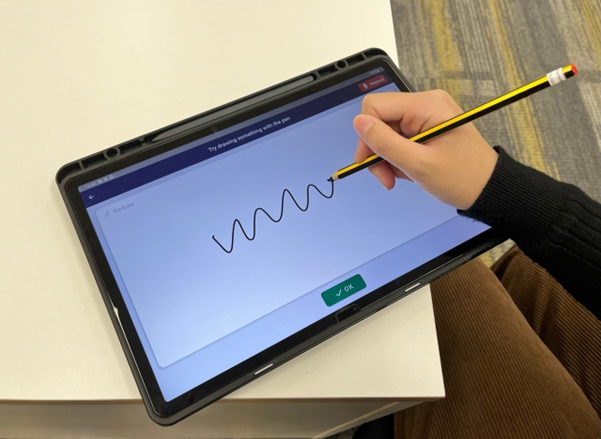
A developed digital application powered by artificial intelligence (AI) takes less than five minutes to identify seniors with early memory problems or pre-dementia, with an accuracy rate of up to 93 per cent.
Patients can use Pensieve-AI, developed by Singapore General Hospital (SGH) and the Government Technology Agency of Singapore, to draw pictures on a tablet with a stylus and the app’s AI will check different areas of thinking and memory before analysing the drawings for signs of pre-dementia.
It will soon replace current screening tools doctors use to assess for dementia, which include using pen and paper to draw a clock and recalling three random unrelated words, such as banana, sunrise and chair.
A Singapore study of the app completed in September 2024 found it achieved an accuracy of 93 per cent in detecting pre-dementia, a result that is as good as the current gold standard of detailed cognitive testing.
The results were published in the scientific journal Nature Communications. Pensieve-AI is slated to be rolled out in 2026.
Dr Liew Tau Ming, a senior consultant in the department of psychiatry at SGH, said the Pensieve-AI test, which comprises four drawing tasks including a clock, can be done by seniors themselves with little or no help in 3½ minutes.
The current test can take up to 30 minutes to complete, depending on the patient’s literacy skills, and needs trained staff to administer.
“It was in June 2020 when we started to discuss and develop the app. A year later, in June 2021, we started our study on whether the AI would be able to detect pre-dementia. We recruited nearly 1,800 seniors aged 65 and above for the study,” Dr Liew said.
Pensieve-AI may become available at community sites, in the form of tablets. It cannot be downloaded to smartphones, to prevent people from learning to draw the images by rote.
“Mild cognitive impairment, or more commonly referred to as pre-dementia, is often missed because it can be mistaken as part of normal ageing. But pre-dementia can show up as more frequent memory lapses, trouble finding the right words, or increasing difficulty managing day-to-day tasks,” he said.
In 2023, it was estimated there were 411,100 Australians living with dementia, according to the Australian Government’s Australian Institute of Health and Welfare (AIHW, which is equivalent to 15 people with dementia per 1,000 Australians, which increases to 84 people with dementia per 1,000 Australians aged 65 and over. Nearly two-thirds (63%) of Australians with dementia are women.
With an ageing and growing population, it is predicted that the number of Australians with dementia will more than double by 2058 to 849,300.
The Australian Government Department of Health, Disability and Ageing has a National Dementia Action Plan 2024–2034.